
The original article is in English – Guest Lecture at the Faculty of Agriculture (December 2025) and the School of Integrated Sciences (January 2026), Kasetsart University, Bangkok, Thailand.
Why Food Scientists Should Care About Carbon
In food science, we often concentrate on protein quality, amino acid profiles, or functional properties. However, the most significant “function” of the winged bean may be something much less visible: its capacity to repair ecosystems. At FoodInnovate’s BTLLAgroforestry field monitoring laboratory of 8 Ha (Site B), we are examining the winged bean not only as a nutritious crop but also as a nature-based climate solution. Our work examines how this plant fits within the emerging framework of global carbon markets and Article 6 cooperation.
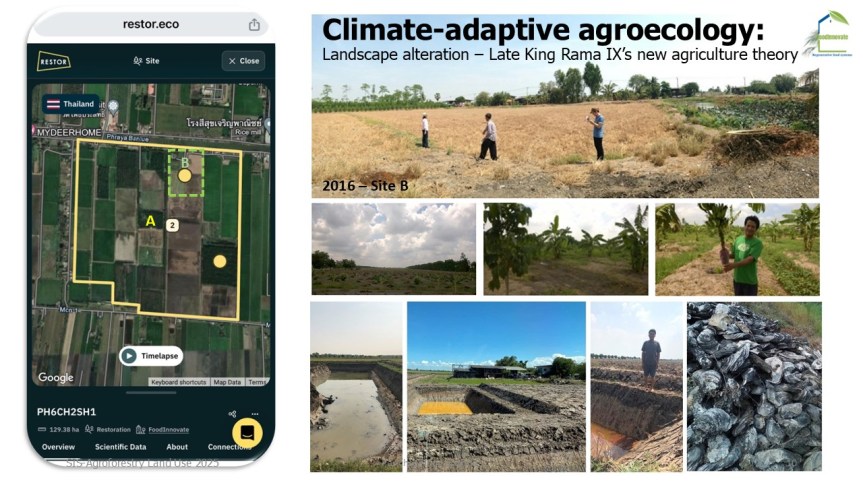
One of the biggest obstacles in climate projects isn’t planting trees—it’s the Transaction Cost of proving that real mitigation has occurred. The winged bean is one of the tools we are testing to help lessen that burden.
A Natural Shield Against N₂O
In agriculture, the most dangerous greenhouse gas isn’t always CO₂. It’s nitrous oxide (N₂O)—mostly released from chemical fertilisers and 273 times more potent than CO₂.
The winged bean helps us tackle this challenge in two elegant ways:
1. Self-Fertilising Power
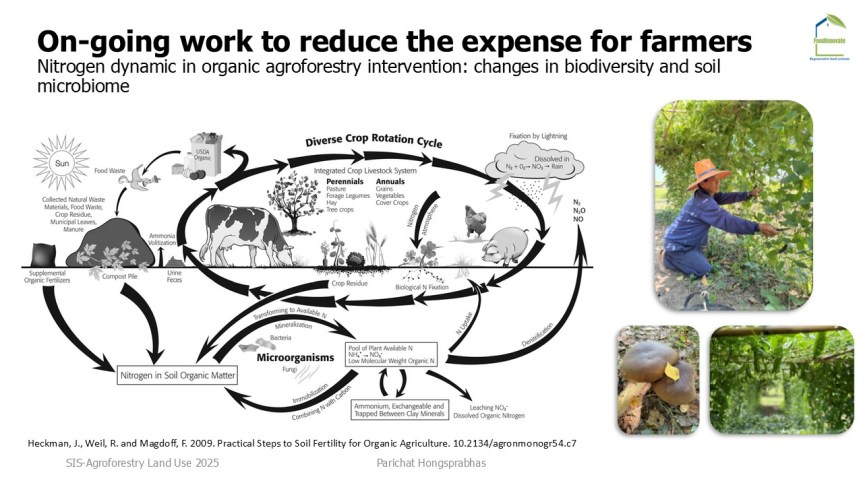
Through symbiosis with soil bacteria, the winged bean fixes atmospheric nitrogen directly into the soil. Farmers can use less chemical fertiliser, which means direct reductions in N₂O emissions.
2. Edible Carbon Storage
Its deep roots and vigorous vines store carbon in the soil, turning the field into an edible carbon sink that regenerates landscapes while producing food.
Making Measurement Easier with High‑Integrity dMRV
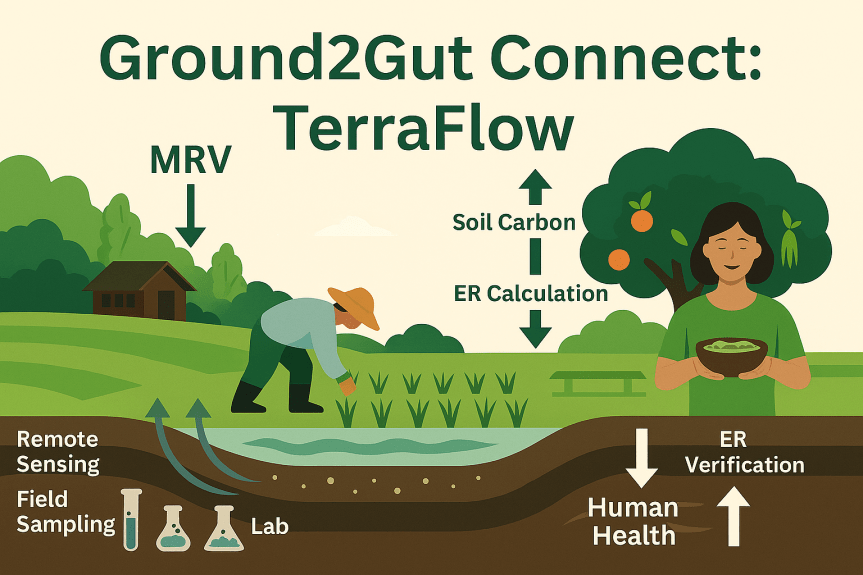
The world increasingly demands high‑integrity, verifiable climate data. That’s why our TerraFlow sandbox in Ayutthaya—8 hectares of Site B is a combination of agroforestry, partial AWD in rice paddies, and a short food supply chain to Bangkok—integrates digital MRV from the ground up.
Here’s what we’ve learned:
- Less Fertiliser = Less Carbon
- All microsites at BTLLAgroforestry have been chemical‑fertiliser-free for more than three years.
- Digital Verification
- Instead of sending people to count trees, we utilise ground-truth data from farmers and satellite-based monitoring through the Open Forest Protocol (https://www.openforestprotocol.org/). This could reduce MRV costs, at least on the agroforestry plot, and make climate finance accessible to smallholders—something long considered impossible.
The Path to 2030
Our upcoming TerraFlow sandbox shows that meeting international standards doesn’t require futuristic technology. With thoughtful landscape design, sustainable agriculture, and the self-sufficiency philosophy of King Rama IX, we can build food systems that are both nutritious and carbon‑neutral.
The winged bean is proof that the future of food is not far away. It’s already growing quietly in our own backyard.
Further readings
https://www.eesi.org/articles/view/laughing-gas-is-no-joke-the-forgotten-greenhouse-gas: Decoding the Future of Plant Proteins from Winged Beans: Ep. 5/6 The Nitrogen-Fixing Frontier in High-Integrity dMRV SandboxCanadell, J.G., P.M.S. Monteiro, M.H. Costa, L. Cotrim da Cunha, P.M. Cox, A.V. Eliseev, S. Henson, M. Ishii, S. Jaccard, C. Koven, A. Lohila, P.K. Patra, S. Piao, J. Rogelj, S. Syampungani, S. Zaehle, and K. Zickfeld, 2021: Global Carbon and other Biogeochemical Cycles and Feedbacks. In Climate Change 2021: The Physical Science Basis. Contribution of Working Group I to the Sixth Assessment Report of the Intergovernmental Panel on Climate Change [Masson-Delmotte, V., P. Zhai, A. Pirani, S.L. Connors, C. Péan, S. Berger, N. Caud, Y. Chen, L. Goldfarb, M.I. Gomis, M. Huang, K. Leitzell, E. Lonnoy, J.B.R. Matthews, T.K. Maycock, T. Waterfield, O. Yelekçi, R. Yu, and B. Zhou (eds.)]. Cambridge University Press, Cambridge, United Kingdom and New York, NY, USA, pp. 673–816, doi: 10.1017/9781009157896.007.
Discover more from À Table! e-Magazine นิตยสารออนไลน์ ครัวของคุณ
Subscribe to get the latest posts sent to your email.

 À Table! e-Magazine นิตยสารออนไลน์ ครัวของคุณ