
The original article is in English
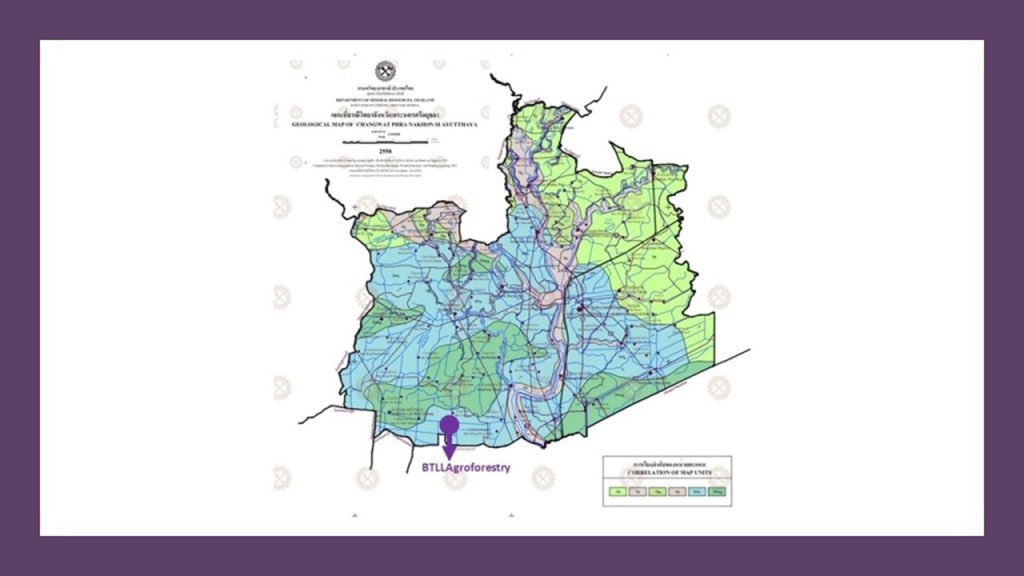
BTLLAgroforestry is located on the tidal flat deposits (shown in blue colour in the figure below) composed of clay and silty clay with light olive grey to light greenish-grey. The soil in the area is very stiff. It has an olive-yellow to yellowish colour, as described by the Department of Mineral Resources, Ministry of Natural Resources and Environment, Thailand (2015). The location of BTLLAgroforestry is only 5-6 km from the mangrove swamp deposits (dark green colour in the west within Lat Bua Luang District). These mangrove swamp deposits are composed of peat, brownish-black, brittle and peaty clay with brownish-grey and brittle texture due to the decomposed stem and fine plant remains.
Although the BTLLAgroforestry site is not exactly right on the peatland – rather on the tidal plain, we began to doubt if we needed to motivate the researchers to consider the Paleo-Gulf of Ayutthaya (currently known as the Gulf of Thailand) and the peat underneath the Bangkok clay if Thailand wishes to enhance carbon sink capacity. The Holocene sediments in the central plain of Chao Phraya river have been classified into 4 units – the basal peat in the bottom, covered by marine unit, followed by tidal unit and fluvial unit on the top. The basal peat developed on the top of the Pleistocene sediments aged between 8,000 to 5,500 yr BP as described by Somboon (1990) and Sinsakul (1992).
Peat swamp forest in Thailand was previously estimated to be 64,555 Ha from on-site exploration (Nuyim, 2003). Most peat swamp forests are in the southern part of Thailand – 30,967 Ha in Narathiwas; 18,946 Ha in Nakorn Si Thammarat; 4,829 Ha in Songkhla; 3,285 Ha in Choomphorn; 2,767 Ha in Phatthalung; 1,590 Ha in Surat Thani; 1,205 Ha in Pattani; 190 Ha in Yala; 92 Ha in Trang; 63 Ha in Phuket and 47 Ha in Krabi. Peat swamp forests of 573 Ha were also present in the eastern part of Thailand, i.e. 453 Ha in Trat and 120 Ha in Rayong.
However, recent CIFOR Global Wetlands https://www2.cifor.org/global-wetlands/ has revealed more peat locations in many countries, including Thailand. This CIFOR platform suggested the peat area in Thailand as 2,063,448 Ha, having a peat volume of 44 cubic kilometers. These newly estimated peat areas, which were not limited to the forest, could serve as a carbon sink in addition to the peat swamp forest globally.
Soil characteristics at BTLLAgroforestry
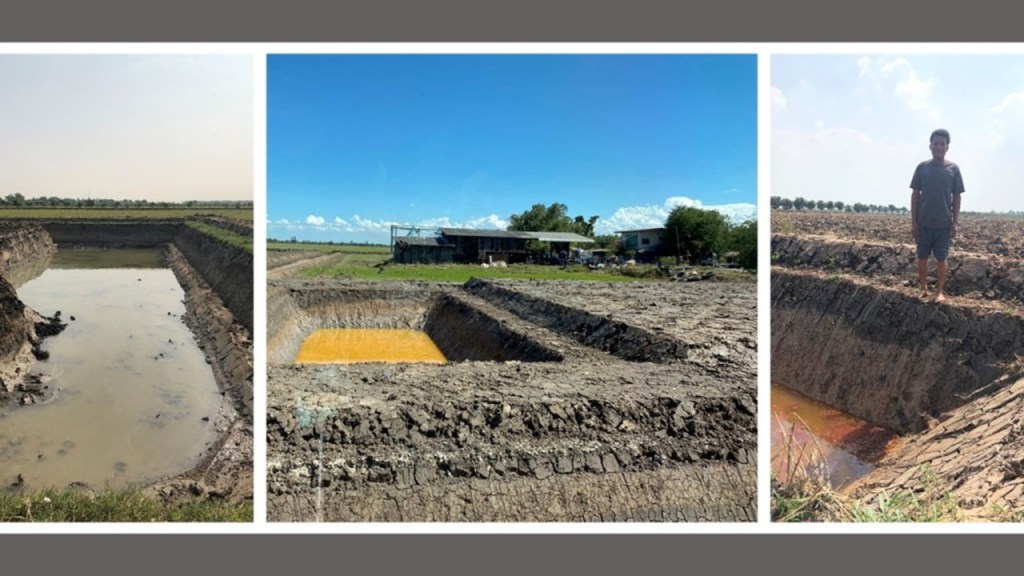
During the first year of the BTLLAgroforestry project in 2016, we had soil analyzed due to the highly acidic pH from pyrite (FeS2) that would further oxidize to a hydrous sulfate of potassium and ferric iron jarosite (KFe3(SO4)2(OH)6). The high acidity and ion unavailability of soil and water in BTLLAgroforestry is driven by inorganic acids, very much different mechanisms from the acid sources in accumulating peat soil.
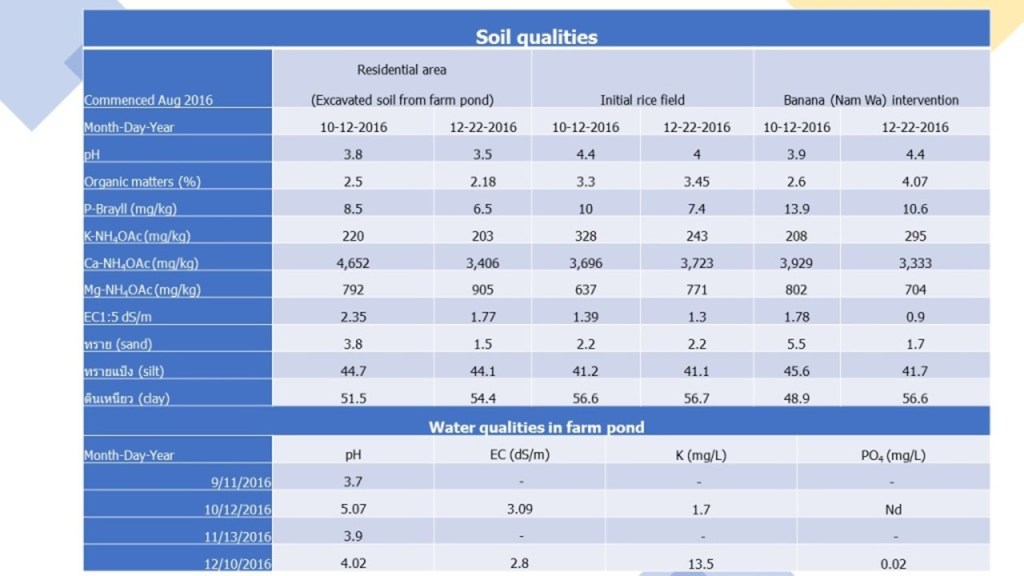
We then decided to use organic approaches in 2016 until now to help de-acidify the soil, change soil microbiome, and soil porosity, e.g. using cow’s, chicken’s, and bat’s manure, burnt rice husk and dolomite CaMg(CO3)2, and planting legumes on a small plot of land of 40 x 40 m, fruit trees and woody trees on the 2 Ha plots after digging the first farm pond – at least to generate buffering capacity to the soil by weak organic acids and organic debris, rather than facing the challenges from strong inorganic acids and unavailability of trace elements for plant growth in our ridge and furrow landscape where we have water logging all year round.
Ecosystem monitoring kindly supported by Restor.eco platform
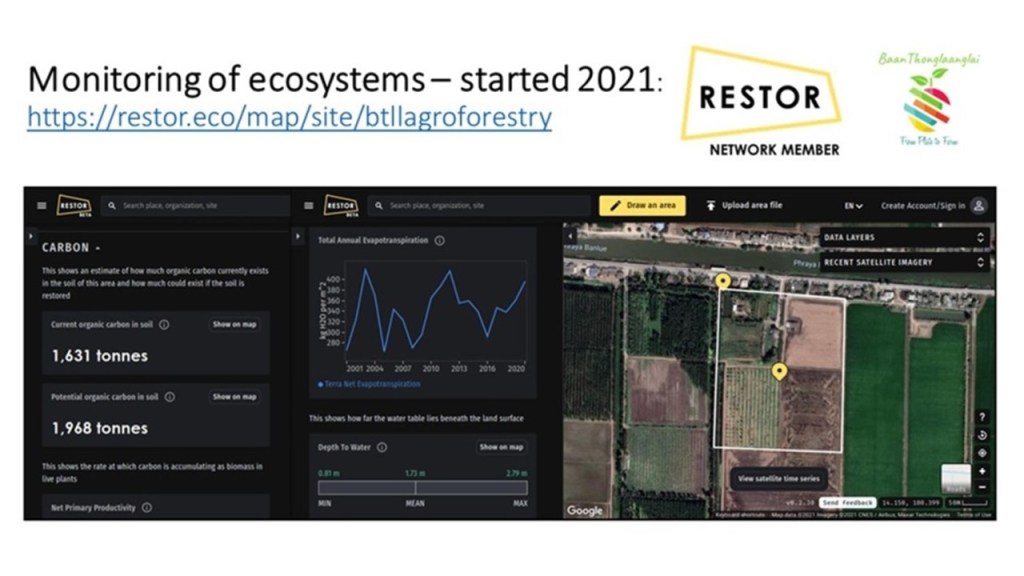
The ecology monitoring helps from Restor.eco geospatial platform in 2021 onwards
Restor.eco geospatial platform https://restor.eco, launched in 2021, has helped us monitor ecological changes back until 2000, particularly carbon accumulation as biomass in live plants, soil carbon and annual evapotranspiration. Currently we can compare our young agroforestry site with mono-crop agriculture sites – original rice fields and eucalyptus forests in the same ecosystem. We have also planted fruit trees and woody trees suggested by the Restor.eco platform and considered the site’s potential on how much organic carbon could exist if the soil is restored.
We have expanded the BTLLAgroforestry site from original 2 Ha in 2016 to 8 Ha in 2021, dedicated to organic farming and using agroforestry intervention to restore the ecosystem. Restor.eco platform helps us understand that the site of 8 Ha has a capacity of almost 2k tonnes for soil carbon but has accumulated only 1.6k tonnes in 2021. The net primary productivity of carbon in the 8 Ha site in 2020 was 37 kg C/year. We hope that it could reach 40 kg C/year in 2022 since our woody trees and fruit trees are already 3 to 5 years old and some are large enough to have DBH more than 5 cm.
BTLLAgroforestry – Solutions for regenerative food systems
BTLLAgroforestry could be the first large-scale organic Agroforestry site in Ayutthaya, an intensively cultivated agricultural landscape. The project could also give the motivations for restoring and managing peat soils in the central region of Thailand in terms of rewetting and smart hydrology for acidic soil, peat or non-peat. However, we are still facing the challenges of balancing economic costs and ecological outcomes during the early to mid phases of the project.
BTLLAgroforestry is entering its 6th year in soil and water restoration and we have intention to grow more woody trees. We started harvesting chemical-free agricultural produce from our fruit trees and monitoring ecosystem parameters. We also aim to supply high-quality fresh agricultural produces and processed products for health and diseases to the aged and bed-ridden individuals as Thailand has become an aging society.
We have started networking with food businesses, domestic and overseas universities, and research institutes. More of the agricultural produces are channeled to the Bangkok market to improve revenues for sustainability of BTLLAgroforestry project and support the livelihood of local communities.
References
Nuyim, T. 2003. http://www.aseanpeat.net/aeimages//File/Publications/Thailand_Peat_manual_rev.pdf
Sinsakul, S. 1992. Evidence of quaternary sea level changes in the coastal areas of Thailand: a review. Journal of Asian Earth Science, 7: 23-37.
Somboon, J.R.P. 1990. Geomorphology of the Chao Phraya delta, Thailand. Ph.D. Thesis, Kyoto University, 86 p.
Discover more from À Table! e-Magazine นิตยสารออนไลน์ ครัวของคุณ
Subscribe to get the latest posts sent to your email.

 À Table! e-Magazine นิตยสารออนไลน์ ครัวของคุณ